
Some codebases are past the point of patching. The original team is gone, every change is a two-week archaeology project, and the stack itself is holding the business back. In financial services, that's not just an engineering headache. It's the system of record for transactions, balances, and customer data, and it's getting more expensive to run every quarter while doing less of what the business now needs.
If you're an engineering leader or architect at a bank, an insurer, a payments company, or a fintech, you already know the shape of this problem. The framework is end-of-life. The people who understood the original design have left. And the codebase has become a constraint on everything the business wants to do next, from launching a new product to meeting a new regulatory requirement.
Xano is where you rebuild the backend, either in parts or all at once. Modern, scalable, and visual, so the system that runs your business is one your team can actually understand, change, and trust again.

A legacy backend gets expensive before it fails
A legacy backend may not be failing, but that doesn’t mean it’s not hurting you. A change that should take a day takes two weeks because no one is sure what else it touches. Onboarding a new engineer means handing them a codebase with no map and the original authors long gone. The framework stops getting security patches, which in a regulated environment is a problem you can't defer indefinitely. And every quarter the system can do a little less of what the business now needs.
The real cost is everything the business can't do because the backend won't let it. New products wait on a system too fragile to extend. Integrations that should take a sprint take a quarter. And the longer the rebuild is deferred, the larger and riskier it becomes, because more gets layered on top of a foundation everyone already knows is failing. Eventually the question isn't whether to rebuild, but whether you do it on your terms or after an outage forces the issue and the regulator starts asking questions.
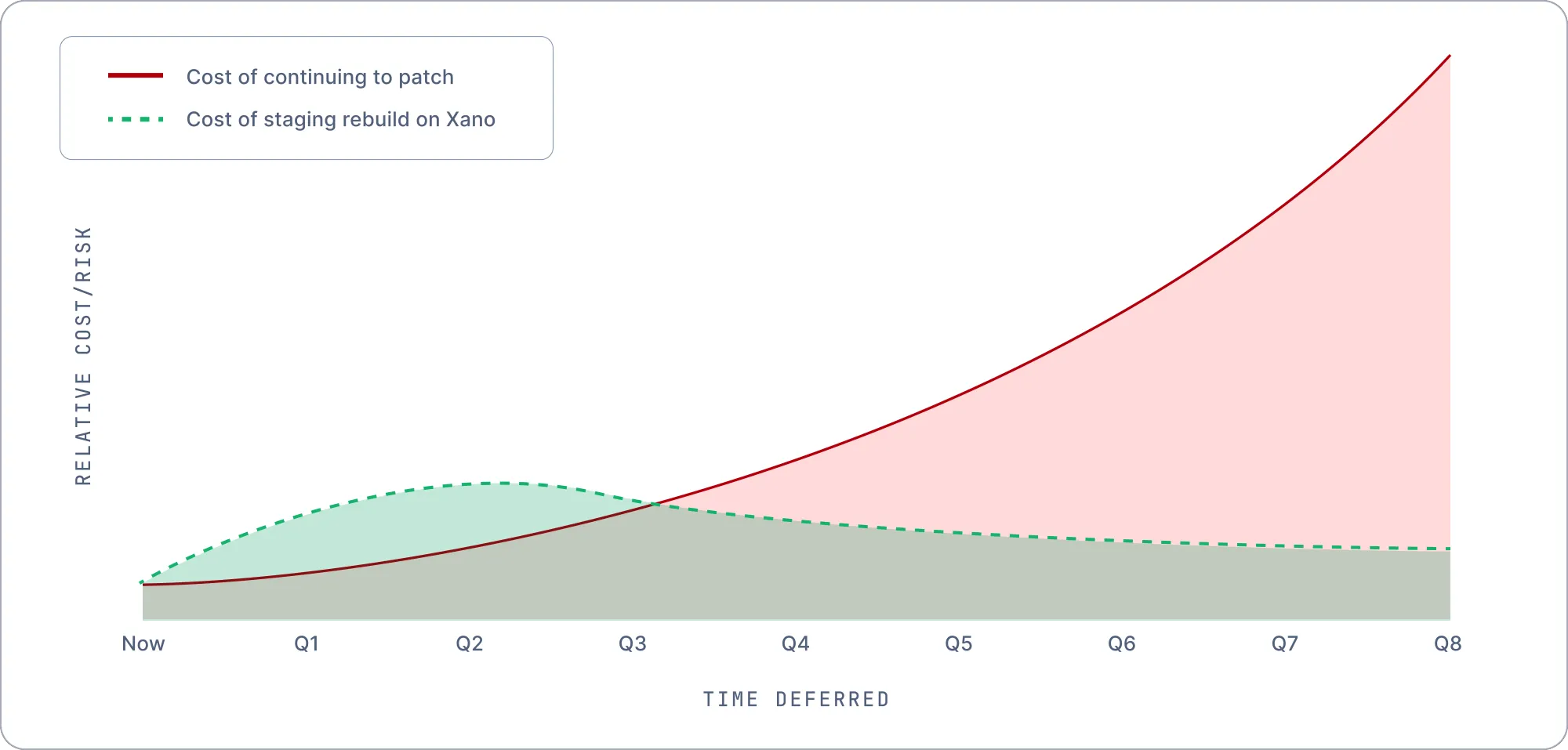
For the engineering leader, it lands as a system you're responsible for but can no longer fully trust, and a rebuild you keep having to justify deferring. Institutional knowledge lives in a handful of engineers' heads or nowhere at all. Every estimate carries a hidden tax for the unknowns buried in code no one has fully read. You know the right move is to rebuild, but a traditional rewrite is a multi-quarter, high-risk project: stand up new infrastructure, re-implement auth and data access, rebuild the deployment pipeline, and migrate data, all while keeping the old system running and the books reconciling.
Why the economics of a rebuild have changed
The reason teams kept patching aging backends instead of replacing them was that a rewrite meant re-doing all the undifferentiated infrastructure, including the database, hosting, auth, scaling, and CI/CD, before writing a line of the logic that actually matters. That's the part that made rebuilds slow, expensive, and risky enough to defer indefinitely.
On a managed backend, that calculus flips. The infrastructure is already there, so a rebuild becomes mostly about re-expressing your business logic in a form your team can finally see and maintain, not reconstructing a stack from the ground up. AI accelerates the same shift, since agents can help translate old logic into the new system far faster than a hand rewrite. The rebuild that was a multi-quarter gamble is now a scoped, achievable project.
Xano works with your existing stack, or replaces the parts you want gone
This matters for financial services teams more than most, because you've invested in tooling you trust and controls you've already gotten through audit. A rebuild can't mean throwing that out.
Xano connects to what you already run. Your observability and APM tooling, like Datadog, New Relic, or Grafana, keeps working. Xano exposes logs, metrics, and request traces you can pipe into the dashboards and alerting your SRE team already lives in. Your CI/CD pipeline can stay in place too, since Xano fits into existing deployment workflows rather than forcing a new one. You rebuild the backend without rebuilding the operational tooling around it.
Or you consolidate. Xano’s managed infrastructure includes built-in observability, logging, and request history, so teams that are tired of stitching together and paying for a half-dozen tools can let the platform handle more of it. Managed PostgreSQL, hosting, scaling, authentication, secrets, backups, and CI/CD are part of the platform. A rebuild that used to start with months of infrastructure work starts with your actual logic instead.
The point is that it's your call. You can do a full rebuild and retire a stack of tools, or keep every integration you depend on and use Xano for the logic layer alone. Most teams land somewhere in between, and Xano supports the whole range.
How the rebuild actually works
Three things make this feasible rather than theoretical.
First, you rebuild the logic as something legible. In Xano, business logic is visual: APIs, workflows, and data flows you can read, reason about, and change. The new system doesn’t just work, it’s understandable by the whole team, so it doesn’t decay back into a codebase only its authors understand. For a regulated business, that legibility doubles as documentation when an auditor asks how a calculation is performed.
Second, the infrastructure is already built, so the project focuses on what's differentiated to your business instead of reconstructing a stack from scratch.
Third, you modernize without downtime. Xano connects to your existing databases and services, so you can rebuild domain by domain and cut over in stages while the old system keeps running. No big-bang switch, and no quarter-long freeze waiting for the new system to be complete before anything ships. For a backend handling live transactions, staged cutover isn’t a nice-to-have. It’s the only responsible way to do it.
And it’s enterprise-grade from day one. Role-based access, encryption, audit-ready logging, and regional or on-prem deployment are built in, so the rebuilt system meets security and compliance requirements without bolting them on later.
What teams are seeing
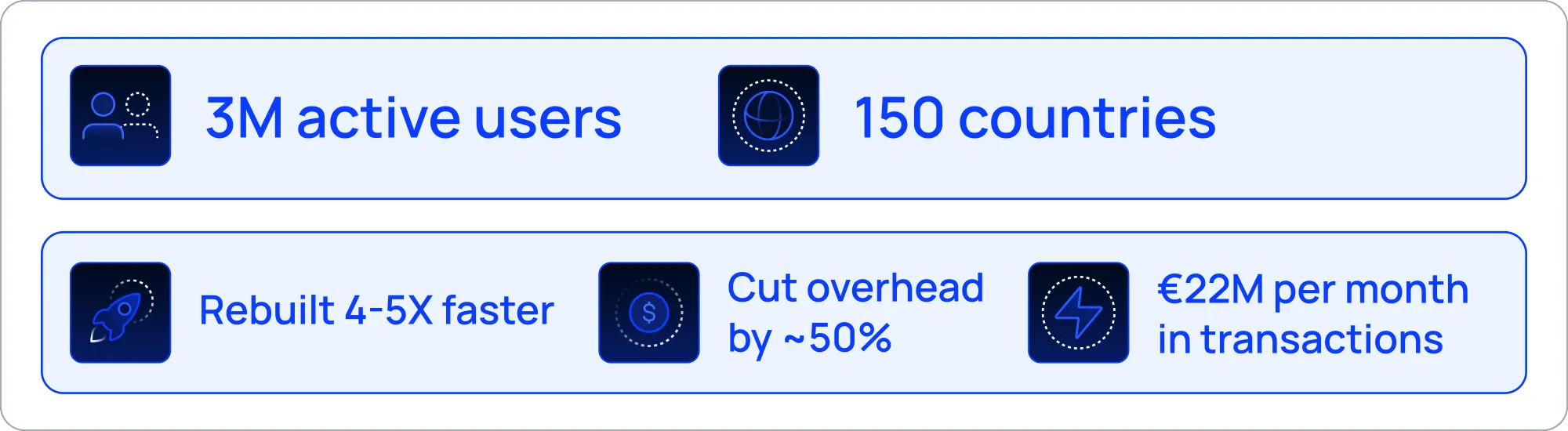
One global trading platform modernized their entire backend to improve UX and engineering agility, standardizing logic across systems and scaling to 3M active users across 150 countries. Another team rebuilt their platform 4 to 5x faster than a traditional approach, cut project team overhead by roughly 50%, and now runs €22M per month in transactions.
Modernize once
The system you stand up on Xano is maintainable, documented by its own visual structure, and scalable, so you’re modernizing once, not setting up the next rewrite your successors will inherit and dread. When an engineer leaves, the logic stays legible. When the business needs something new, the system can actually extend to meet it. When an auditor asks, the answer is in front of you.
The best way to see whether this fits your stack is to walk through it with us against your actual architecture, including the tools you want to keep and the ones you'd like to retire.
Request a demo to see how a rebuild would work for your backend, or try Xano for free and start with a single domain.