
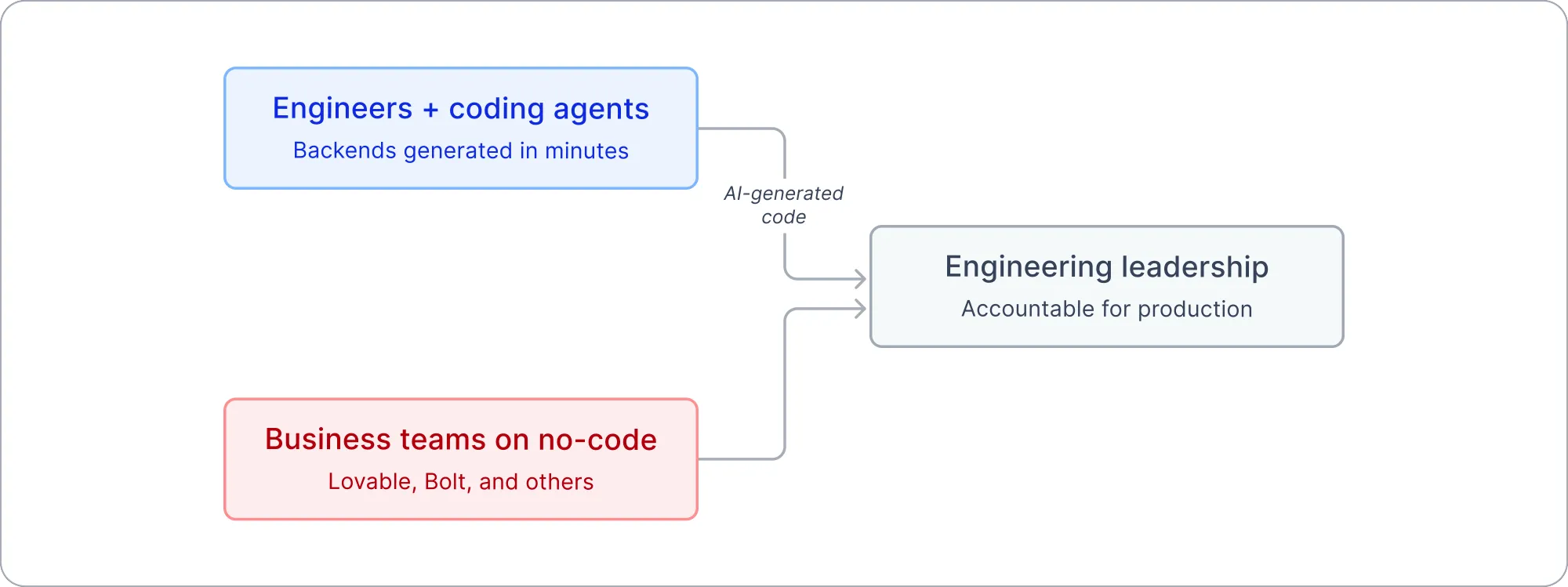
AI writes backend code now. Your engineers drive it with agents, and increasingly, so do people who don't report to you—operations, finance, and product teams shipping internal tools on Lovable, Bolt, and whatever launches next quarter. The code shows up syntactically clean and demo-ready. The hard part is trusting it enough to run it in production—where it touches account balances, transaction records, and customer PII—and that problem lands on engineering leadership no matter who generated the code.
In financial services, "trusting it enough" isn't a figure of speech. The same code that moves money is the code your auditors will examine, your regulators can subpoena, and your customers will hold you to. Speed at the expense of control is a liability.
Two sources, one owner
You already know the problem, because you're living both sides of it. Inside engineering, an agent generates an entire backend in minutes—a payments service, a ledger update, a KYC workflow—and what it doesn't come with is any structured way to confirm the logic is correct, the edge cases are handled, or the data access is safe. A rounding error in an interest calculation or a missing check on a transfer limit doesn't announce itself in a demo.
Outside engineering, a business team builds a tool that demos beautifully, a sponsor champions it, and it reaches you with organizational momentum and a backend that was never really built. Now it's reconciling balances or surfacing customer data, and no one asked whether it should.
Both streams converge on the same person. You're accountable for code your team wrote with AI and for code people you don't manage wrote with AI, on stacks you didn't choose—and you're accountable to a regulator who doesn't care which keyboard it came from. If you're the enterprise architect, the problem is sharper still: you're supposed to be able to say how things get built here, and right now you can't, because half of it is being built in places your standards never reached.
The usual controls don't close the gap, because they were built for human-speed output. Line-by-line review doesn't scale to entire backends generated on demand across more services than any one person tracks. Agent guardrails govern what the model is allowed to attempt, not what actually reaches production—a well-constrained agent still ships logic that's valid and wrong, and "valid and wrong" in a financial system is a misposted transaction or a control that silently fails. And none of it touches the code coming from outside engineering, which never entered your review process to begin with.
Gartner projects that prompt-to-app approaches will increase software defects by 2500%. In an industry where a single defect can mean a reporting violation or customer harm, you can't review your way out of that at AI speed. The governance has to live somewhere more structural.
Governance belongs in the backend
The backend is the right place for this because it's the one layer every piece of AI-generated code has to pass through. Frontends vary, agents vary, the people prompting them vary. The backend is the common ground—it's also where the money moves, the records of authority live, and the controls actually have to hold. If governance lives there, it applies to everything regardless of where the code came from. Xano is focused on making AI-generated code safe, with four things that make AI output something you can actually put your name on—and put in front of an examiner.
Every team builds to the same standard, by construction. This is the part that changes an enterprise architect's job. Xano is opinionated: APIs are built the same way regardless of who—or what—is building them. Auth, input validation, error handling, data access, naming, the shape of a request and response—these follow the platform's conventions rather than each team's, and each agent's, improvisation. You don't publish a standard and hope it's followed across a dozen teams and as many AI tools; the standard is the environment they build in. And because it's enforced structurally, it's also observable: As the EA, you can actually see that the payments team's API and the finance team's prototype were built the same way, to the same rules, instead of taking it on faith and finding out during an audit that they weren't. One pattern, applied everywhere, that you can point to.
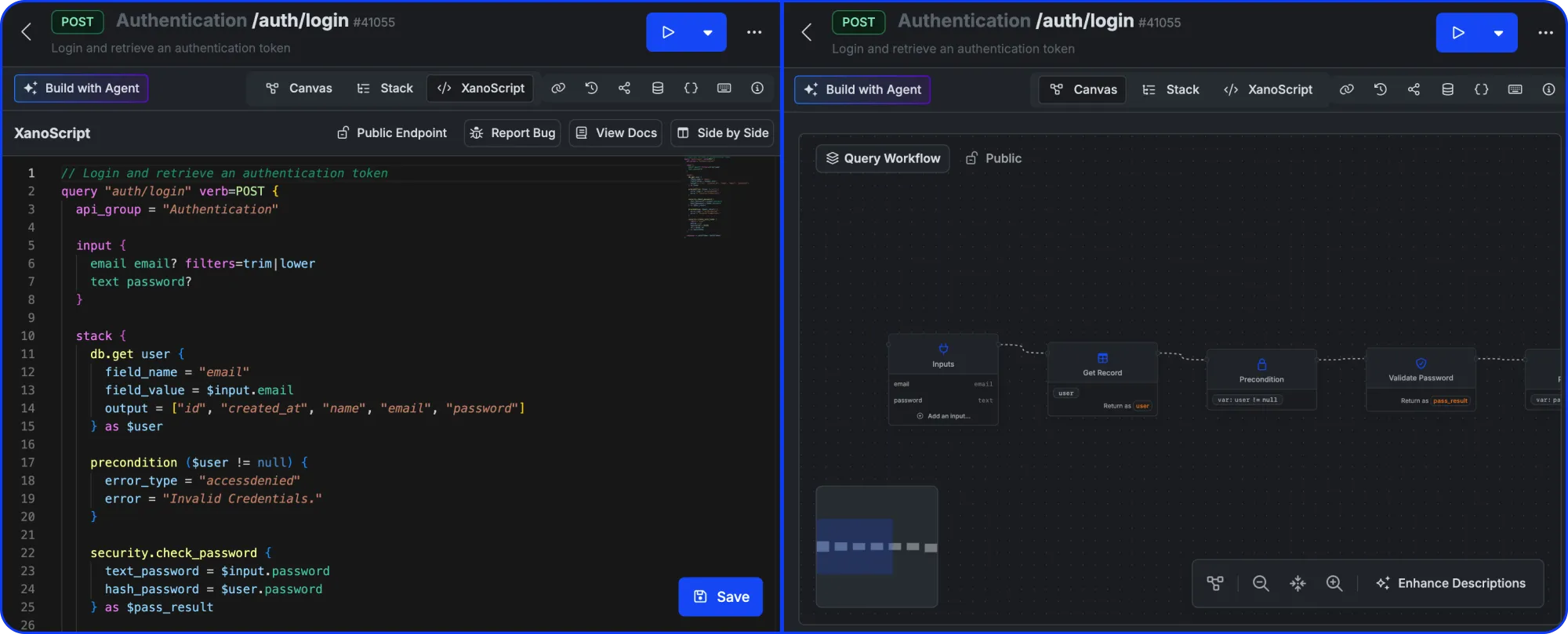
You validate logic without reading every line. In Xano, business logic is visual. Your team inspects and reasons about what a system does at the level of data flows, execution paths, and edge cases—the transaction limit, the eligibility check, the path a payment takes when a balance is insufficient—rather than scanning raw code line by line. This is a review that scales when AI is generating whole backends, and it gives engineering a shared language to reason about a finance team's tool as easily as its own. When a control needs to be demonstrable, you can point to it.
Nothing reaches production untested. You spin up ephemeral, isolated sandboxes that mirror your real workspace, so AI-generated code gets tested against real conditions—real data shapes, real edge cases, real failure modes—before it's promoted. Logic develops on separate branches, and it goes live only when a human approves it, through a repeatable generate, validate, test, deploy loop. That human approval step is also your segregation-of-duties checkpoint: the person who approves isn't the agent that wrote it. The agent stays fast. Production stays governed.
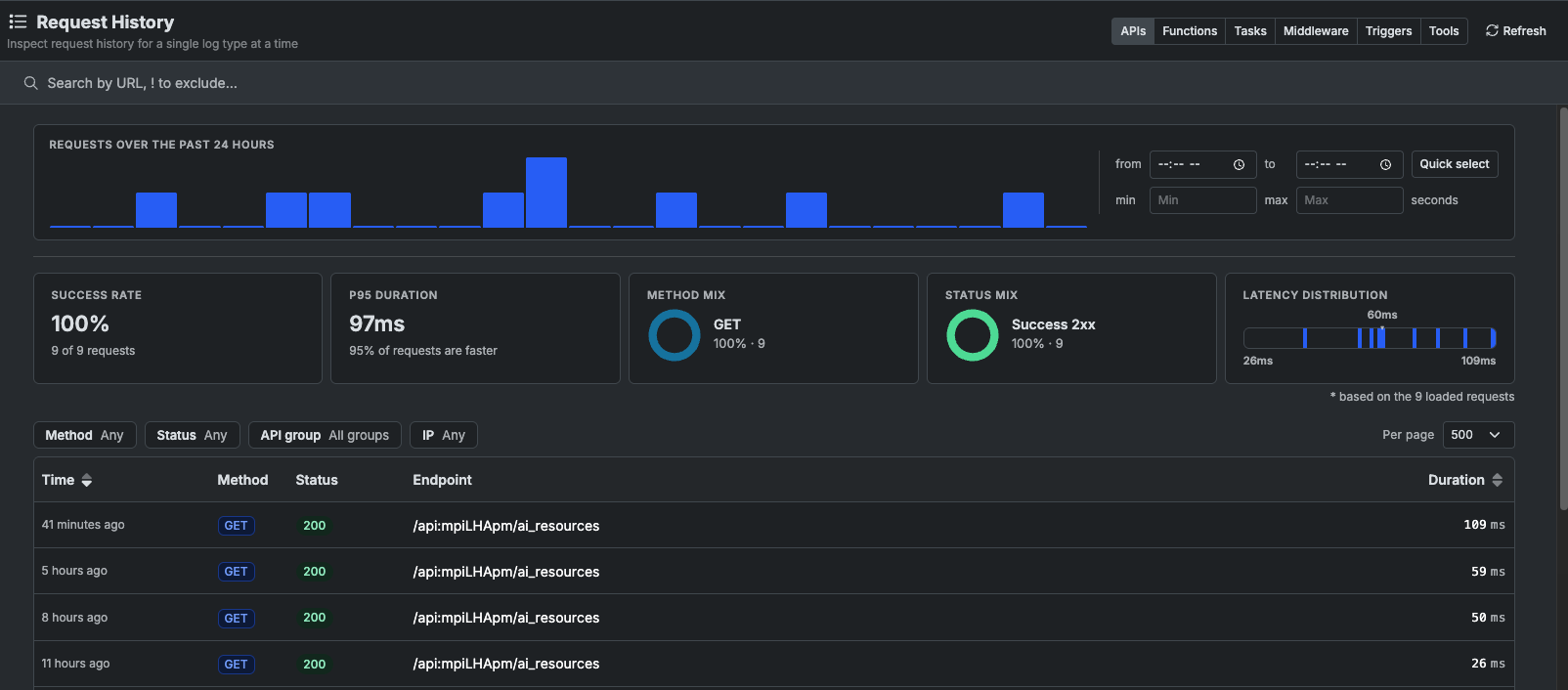
When something breaks, you find it immediately. Generic monitoring tells you the error rate spiked and the latency is bad, then leaves your team to dig through logs, repos, and deploy history to figure out where—while transactions are failing and the clock on your incident-reporting obligations is already running. Xano drills from the alert straight to the function: the slow step, when it was last modified and by which agent, the version, and the full audit trail of who reviewed it and how it was promoted. When AI is writing code across dozens of services, root cause can't be a manual investigation—and "we'll know by next week" isn't an answer you can give a regulator.
The same capabilities handle both streams of AI code, and they hold to the same standard across both. When an engineer drives an agent, Xano's Developer MCP grounds it in real platform rules from the start—so the agent builds to your conventions instead of inventing its own—and the CLI plugs into existing CI/CD. When a business team builds a prototype, the production-grade backend underneath already carries the same conventions and the security and compliance posture that survives enterprise and regulatory review, including SOC 2 Type II, ISO 27001, HIPAA, and GDPR. One governance model, one standard, not two of each. As Erik H., a developer building on Xano, put it:

What this changes
You can make it so that speed and trust stop being a trade-off. Engineers keep shipping with agents. Business teams keep building their tools. Both build to one standard you can enforce and actually see being followed. And the person accountable for all of it (yes, you) has a single, structural way to confirm that what's running in production is correct, tested, and traceable—and to prove it when someone asks.
That's the difference between AI that accelerates your roadmap and AI that fills your production environment with code no one can vouch for—the kind that turns into a finding, an incident, or a headline.
If AI-generated code is already reaching your production environment from more directions than your review process can cover, see what governing it in the backend looks like. Request a demo and we'll walk through it against your own stack, or try Xano for free and build on it yourself.