AI can now generate APIs, business logic, and full backend workflows in minutes. The productivity gains are real. What's harder is trusting what got built, because AI-generated code routinely goes straight into production without a structured way to validate what it actually does.
Code production isn't the hard part anymore. Trust is.
That's the shift we're building Xano for.
Governance Has to Live in the Backend
The natural checkpoints that used to govern software, code reviews, design docs, staging environments, shared standards, were built around human-speed output. At AI speed, they either disappear or stop scaling.
Governance can't be bolted on to code that's already running. Runtime enforcement, sandboxed validation, audit trails, rollback: these only work if the platform running the logic is also the platform governing it.
Xano isn't a governance tool layered next to a backend. It's the backend, and that's why the governance works.
What We Built (and how we’ve evolved)
We started Xano in 2020 with a specific bet: that business logic deserved to live somewhere legible, not buried in application code. That infrastructure work shouldn't stand between a team and production. That visual logic wasn't a training-wheels abstraction but a better way to understand what systems do.
At the time, the category that fit was no-code. That's where those principles found their first audience. We built a visual workflow engine, managed infrastructure, and an opinionated function stack because we believed serious backend development should be accessible to teams without dedicated backend engineers. That belief hasn't changed. What's changed is who else now needs the same things: AI agents, enterprise platform teams, compliance leads, cross-functional squads.
None of those bets were predictions about AI. They were bets about what a production backend should look like, regardless of who was building on it. The AI era didn't invalidate them. It extended them.
The visual workflow engine we built so non-engineers could read a backend is what keeps humans in the loop when an agent builds one. The managed infrastructure that let small teams ship without a DevOps practice is what lets enterprises absorb AI-generated volume without a ballooning operations headcount. The opinionated function stack that made backend logic approachable is what gives AI agents the guardrails they need to generate logic that runs reliably.
XanoScript formalized the last piece. It gives agents a way to author backend logic as code that maps directly to the visual execution environment. Not a translation layer. A shared representation. That's what makes the "build with AI, validate visually" loop possible.
Five years in, those principles, accessibility, visibility, managed complexity, matter more than ever. The market is demanding exactly what they produce.
What Governance Actually Requires
Three things have to be true for AI-generated logic to be trustworthy in production.
Structure. You can't govern chaos. XanoScript channels AI output into consistent, enforceable patterns that are inspectable, testable, and auditable by design. Every agent that builds in Xano builds the same way. No architectural drift across projects, teams, or agents.
Visibility. Engineering, security, compliance, and product leaders all need to understand what a workflow does. In Xano, business logic is visual. Data flows, transforms, inputs, outputs, and runtime behavior are all legible. That visibility doesn't go away because AI wrote the logic.
Safety. Ephemeral sandboxes for isolated testing. Human review before deployment. Rollback. A full audit trail of what changed and why. Speed without these is a liability, not a feature.
How Xano Does This Today
None of this matters if it only works in theory. Today, four capabilities put it in teams' hands.
- The Xano CLI gives engineering teams operational control over AI-assisted workflows. Manage environments and branches, sync XanoScript locally, automate backend operations, plug into existing CI/CD. It enforces a repeatable loop: generate, validate, test, deploy.
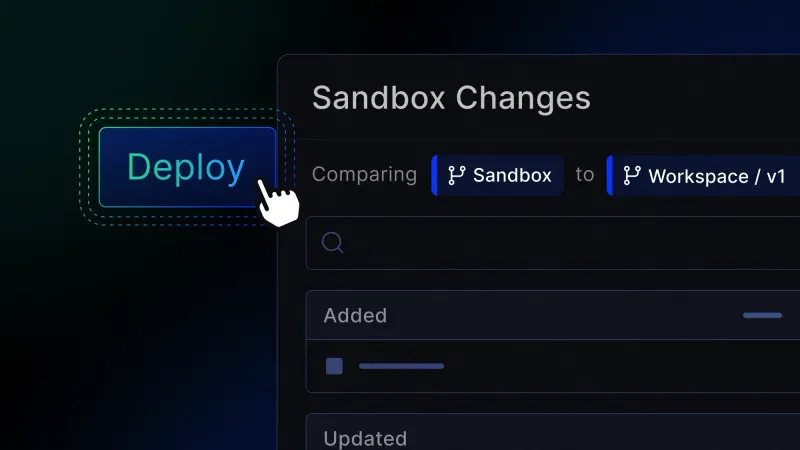
- Ephemeral sandboxes, spun up directly from the CLI, close the gap between generation and production. An isolated environment that mirrors your exact workspace state. Test AI-generated changes against it, tear it down. No staging setup, no environment drift.
- The Developer MCP addresses the root cause of most AI backend failures: agents building without knowing the rules of the system. It connects agents directly to Xano's documentation, platform APIs, and the XanoScript language server, so output is grounded in actual platform rules from the start.
- The Xano Agent helps those working with natural language convert intent into production-ready backends. Everything it generates is still inspectable, testable, and governed the same way.
All of this is available today in Xano 2.3.
Enterprises Are Already Doing This With Xano
AssetMark uses Xano as a governed backend between their internal platforms and external vendors, deployed in their own locked-down Azure environment. They've said Xano helped them "free the business logic from code," and they're training cross-functional squads of engineers and product managers to build on it, because the visual interface creates a shared language across disciplines.
Deriv runs 26 domain-specific services on Xano, executing critical trading logic across external ledger systems for over 3+ million users in 150 countries.
Europ Assistance built a global travel assistance platform on Xano that will orchestrate more than a million emergency cases per year.
These aren't demos. They're the governed backend in production.
Built for Teams Who Care What They Ship
The teams winning with AI aren't the ones generating the most code. They're the ones who know that business logic is what makes their company unique, and who have the guardrails to manage it, protect it, and keep building on it safely.
Software is changing faster than it ever has. Xano is evolving with it, built on the same principles that guided us from the start: logic should be legible, backends should be governed, and speed should never come at the cost of trust.
If that's how you think about building, we're built for you.