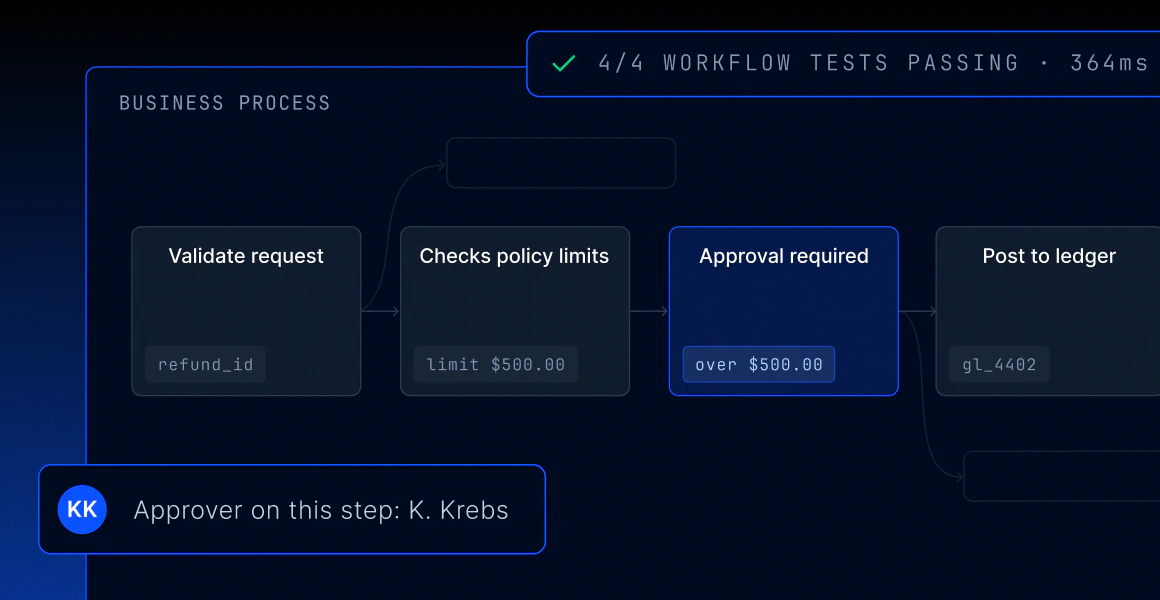
How AI has changed
visual coding

When AI writes code, the hardest part of building applications becomes validating logic. Xano gives developers a visual layer for understanding, adjusting, and governing backend behavior, so AI-generated systems stay reviewable, trustworthy, and production-ready.

Validate workflows

Validate workflows

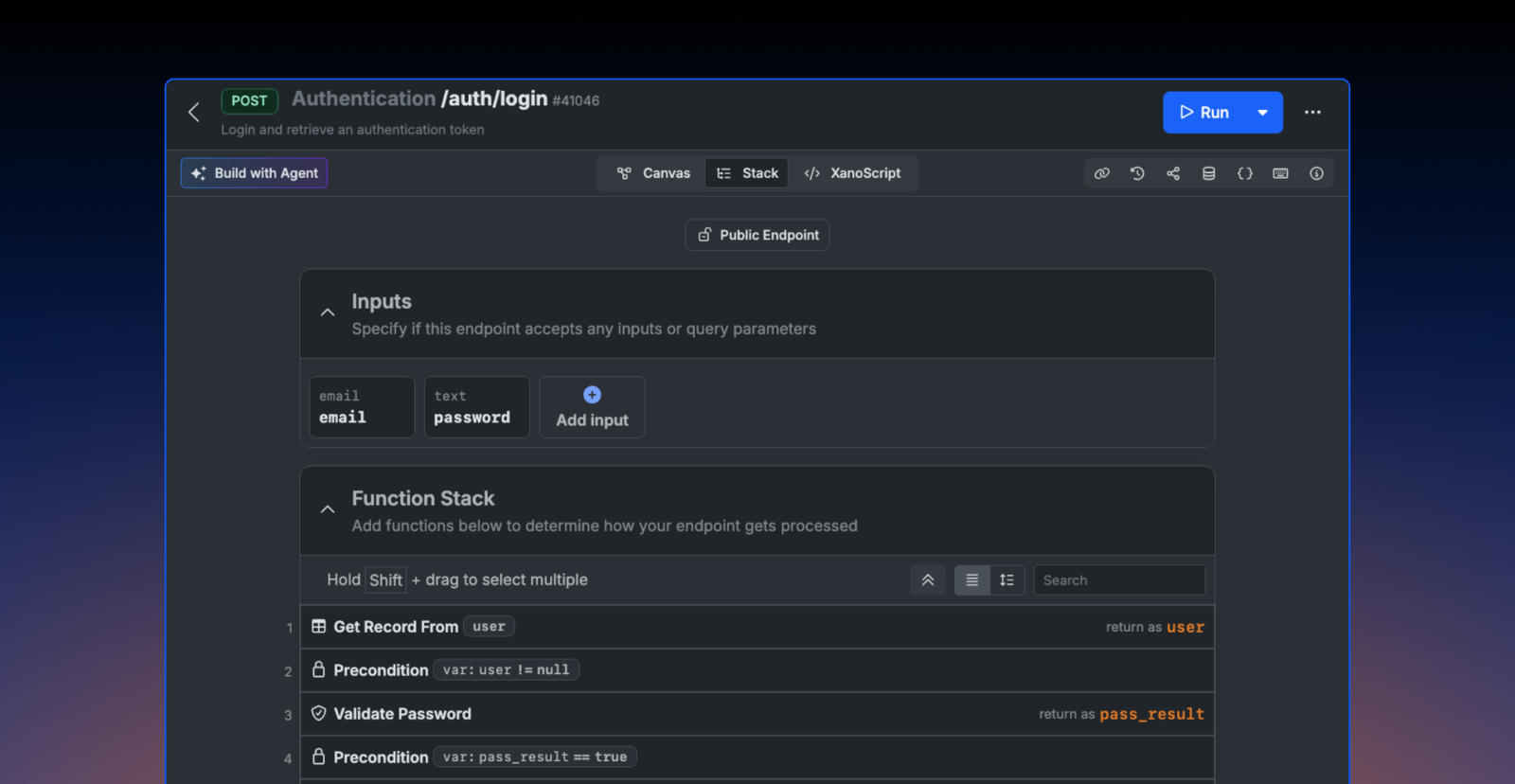
Let humans check AI’s work without line-reading code.

Identify logic errors

Identify logic errors

Quickly spot errors before they run.

Debug easily

Debug easily

Fix problems in a visual representation of AI’s work.

AI reduces code‑writing, but increases risk

AI can generate thousands of lines of syntactically valid code in seconds. But when code is produced faster than it can be reviewed, developers face a new problem: understanding and governing that code.

The failures aren’t syntax errors anymore. They’re logic errors—wrong assumptions, flawed edge cases, unclear data flow, insecure behavior, and unintended side effects that are hard to see until something breaks.

“A new class of defect is emerging as AI generates context-deficient code. While syntactically correct, AI output often lacks awareness of the broader system architecture and nuanced business rules, introducing subtle but severe flaws.”

(Gartner, 2026 Predicts: AI Potential and Risks Emerge in Software Engineering Technologies)

The questions every team needs to answer

AI-generated backend logic can be powerful—but only if teams can see, understand, and govern what was built. Here are the critical questions every team should be asking.

Question

How do we validate what AI built?

Not “does it compile?”—but does it behave correctly end-to-end?

Question

How do we ensure it’s secure and maintainable over time?

Can we review changes, understand impact, and keep logic governable as it evolves?

Question

How do we share understanding across stakeholders?

Can developers, product, and the business align on what the system actually does?

How to Incorporate AI into the SDLC

How to Incorporate AI into the SDLC

Learn how development teams are embedding AI into their software development lifecycle—from design through deployment—while maintaining visibility, governance, and production readiness.

Read the blog

Visual development → visual validation

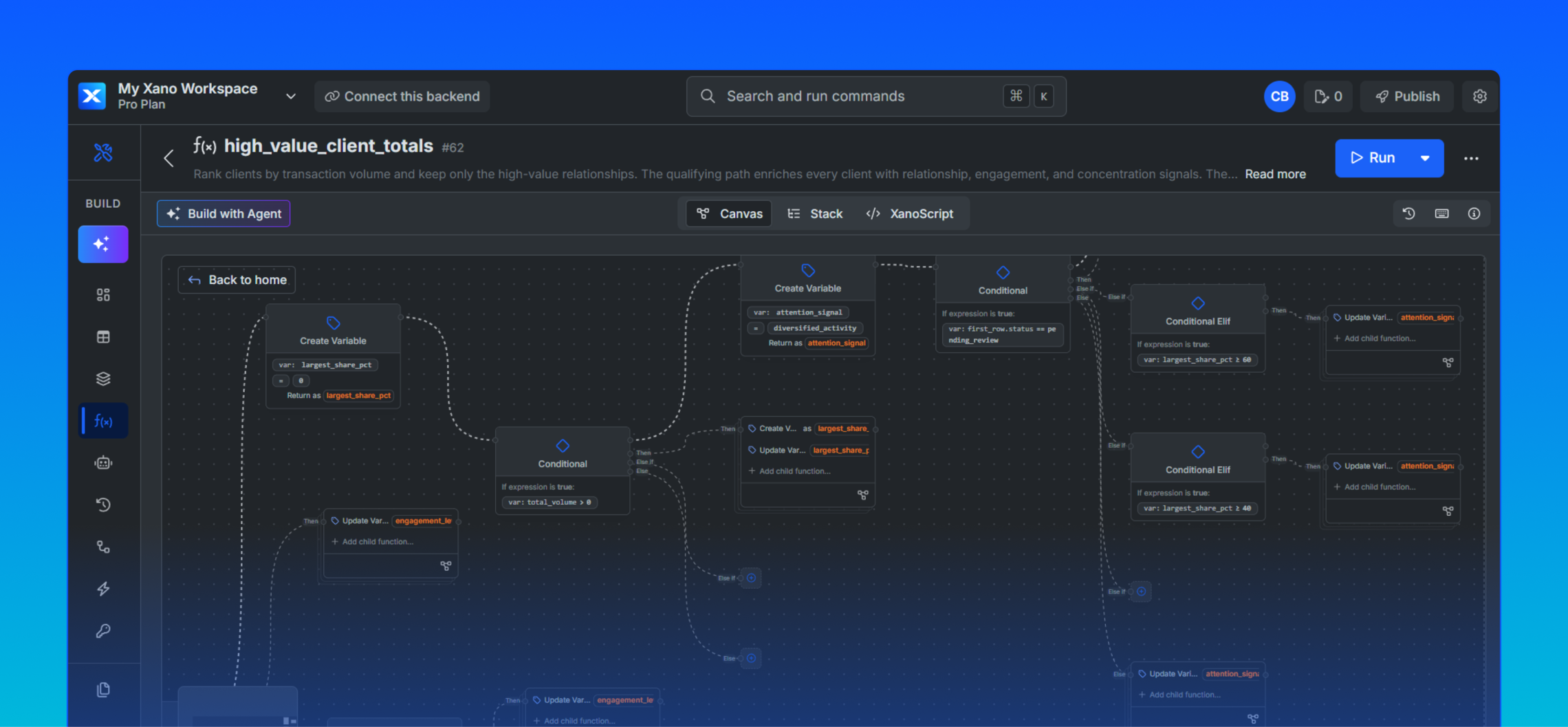
Visual development used to be a way to abstract code away from non-technical users: drag-and-drop builders, flowcharts, and no-code tools that let people ship without writing code.

With AI, that emphasis has shifted. The modern role of visual development isn’t to replace code creation—it’s to complement it, providing a visual layer where developers can inspect, reason about, and refine system behavior before it runs in production.

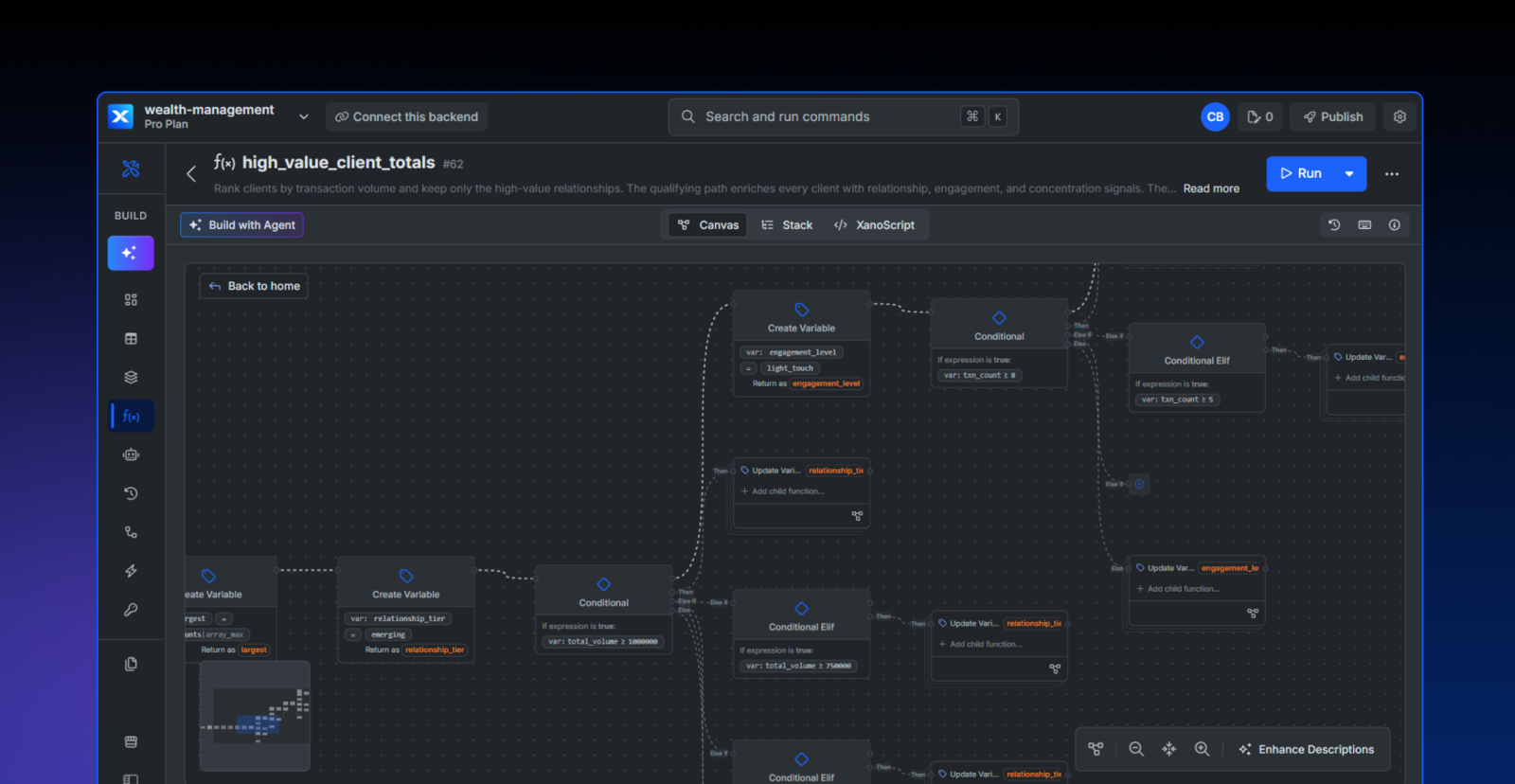
Visual development interface

Visual development differentiates AI
slop from good code

With visual development, you can:

Check

Flip between the visual layer and the code layer

Check

Inspect what was generated

Check

Reason about behavior and edge cases

Check

Confirm correctness before production

Check

Make changes safely

Check

Collaborate with technical + less-technical stakeholders

Xano gives your team
the AI advantage

Xano doesn’t hide complexity—it makes it explicit and inspectable.

Xano doesn’t hide complexity—it makes it explicit and inspectable.

Visual logic represents real execution paths, not mock abstractions.

Visual logic represents real execution paths, not mock abstractions.

AI-generated logic can be reviewed, edited, and validated visually before it impacts production data or users.

AI-generated logic can be reviewed, edited, and validated visually before it impacts production data or users.

Build, connect, and scale your backend with confidence—powered by Xano.

Frequently asked questions

What is visual development?

Visual development is the practice of building, understanding, and reasoning about software systems through structured visual representations—such as logic flows, execution paths, data relationships, and schemas—rather than relying only on raw source code.

In modern systems, visual development is less about how code is written and more about how behavior is inspected, refined, validated, and governed.

Traditional no-code and low-code tools focused on hiding complexity so non-developers could build applications without writing code.

Modern visual development, especially in an AI context, takes a different approach: it makes complexity explicit and inspectable so teams can validate correctness, understand behavior, and maintain control over systems—even when code is generated by AI.

AI has removed code writing as the primary bottleneck in software development. Models can generate large amounts of syntactically correct code very quickly.

The new bottleneck is validation: understanding whether that code is logically correct, secure, maintainable, and aligned with system architecture and business rules. Visual development provides a way to reason about system behavior without relying solely on manual code review or post-deployment debugging.

Line-by-line code review was designed for human-written code, not for AI-generated systems that can change rapidly and span many files and services.

Visual validation complements code review and hands-on debugging by showing real execution paths, data flow, and dependencies, making it easier to catch logic errors, edge cases, and unintended behavior before deployment.

No. Visual development does not replace code—especially in modern systems where code may be written by humans, AI, or both.

Instead, it provides a layer for shaping, validating, and orchestrating logic that makes generated logic visible, reviewable, and governable, regardless of how the underlying code was produced.

By making system behavior explicit before deployment, visual development helps teams:

  • Identify logic flaws earlier
  • Validate assumptions about data flow and edge cases
  • Reduce reliance on logs and alerts after failures occur
  • Ship changes with greater confidence

This shifts quality and reliability work left, rather than treating it as a reactive process.

Most platforms treat visual development as a way to simplify or abstract systems. Xano treats visual development as a source of truth for backend behavior:

  • Visual logic represents real execution paths
  • Complexity is exposed, not hidden
  • AI-generated logic can be inspected, edited, and validated visually
  • The visual model reflects what actually runs in production

This makes Xano uniquely suited for understanding, shaping, and validating AI-generated backends.

Yes. Xano fully supports custom code, external services, and advanced backend logic. Visual development in Xano exists alongside code—not instead of it—giving developers flexibility to design, adjust, and govern backend behavior without sacrificing visibility or control.

No. While visual representations can help product managers or business stakeholders understand system behavior, the primary value is for developers and engineering leaders. Visual development helps technical teams reason about complex systems faster, align on behavior, and maintain clarity as applications scale.

As systems grow and evolve—especially those built with AI assistance—maintainability depends on shared understanding. Visual development creates a durable, inspectable model of backend behavior that survives team changes, refactors, and feature growth, helping organizations avoid brittle, opaque systems over time.

Sign up for Xano

Join 100,000+ people already building with Xano.

Start today and scale to millions.

Start building for free